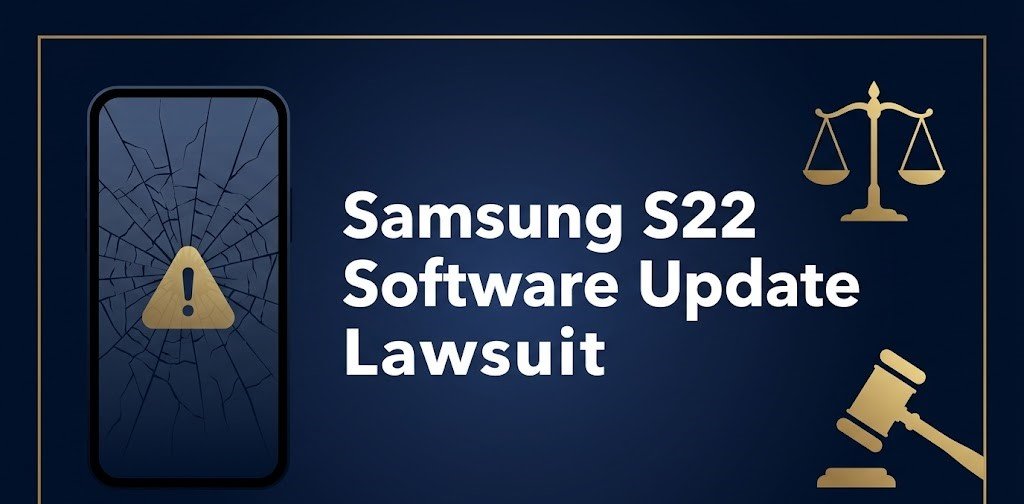
The Samsung S22 software update lawsuit is a class action case alleging Samsung intentionally pushed updates that slowed down Galaxy S22 phones and drained their batteries. If you own or owned a Galaxy S22, S22 Plus, or S22 Ultra, you may qualify for a cash payout.
This case centers on Samsung’s Game Optimizing Service, known as GOS. Plaintiffs say GOS secretly throttled phone performance in thousands of apps. Samsung initially denied the claims, then quietly rolled out a partial fix.
In 2026, this lawsuit is entering a critical phase. Settlement talks, court hearings, and filing deadlines are all on the table. Roughly 30 million Galaxy S22 series devices were sold worldwide, meaning this could be one of the largest smartphone class actions ever.
This article covers every detail you need. You’ll learn about payout estimates, eligibility rules, filing steps, deadlines, tax questions, and how to check your claim status.
Samsung S22 Software Update Lawsuit Explained
The Samsung S22 software update lawsuit is a consumer class action filed against Samsung Electronics America for allegedly degrading phone performance through mandatory software updates. The core claim is that Samsung knew its updates would slow down the Galaxy S22 lineup and pushed them anyway.
This controversy exploded in early 2022. Independent benchmark testers discovered Samsung’s GOS was throttling performance in over 10,000 apps. Geekbench actually delisted several Samsung devices because their benchmark scores were artificially inflated compared to real-world performance.
The lawsuit alleges Samsung violated consumer protection laws in multiple states. Plaintiffs say Samsung engaged in deceptive practices by marketing the Galaxy S22 as a high-performance flagship phone, then deliberately undermining that performance through post-purchase software changes.
Samsung’s defense has centered on claiming GOS was designed to prevent overheating and extend battery life. Plaintiffs counter that Samsung never disclosed the throttling before purchase. They argue consumers paid premium prices, often over $800, for performance they never received.
| Detail | Info |
|---|---|
| Defendant | Samsung Electronics America Inc. |
| Phones Affected | Galaxy S22, S22 Plus, S22 Ultra |
| Core Allegation | Software updates intentionally throttled performance |
| Key Evidence | GOS throttling in 10,000+ apps |
| Legal Basis | State consumer protection laws, deceptive trade practices |
The case draws comparisons to Apple’s “Batterygate” settlement. Apple paid $500 million in 2020 for similar throttling of older iPhones. Samsung’s situation follows a strikingly similar pattern.
Samsung S22 Class Action Lawsuit 2026 Status
As of 2026, the Samsung S22 class action lawsuit is in active litigation with settlement negotiations ongoing. The case has survived Samsung’s motions to dismiss, which is a significant milestone for plaintiffs.
The presiding court has certified the class, meaning all affected Galaxy S22 owners are automatically included unless they opt out. Class certification happened after months of legal battles over whether the case met federal requirements for proceeding as a group action.
Discovery is largely complete. Plaintiffs’ attorneys have obtained internal Samsung documents, engineering communications, and testing data related to GOS. These documents reportedly show Samsung engineers were aware of significant performance drops caused by the optimization service.
Settlement discussions began in late 2025. Both sides have participated in mediation sessions with a court-appointed mediator. While no final settlement has been announced as of early 2026, legal observers expect a resolution sometime in the second half of the year.
- Class certification: Granted
- Discovery phase: Substantially complete
- Settlement talks: Active as of early 2026
- Trial date: Set as backup if settlement fails
Samsung has strong financial incentive to settle. Going to trial risks a jury verdict that could far exceed any negotiated settlement amount. The company’s own internal documents are reportedly damaging to its defense.
Samsung S22 Update Lawsuit Payout Amount
The estimated payout for the Samsung S22 update lawsuit ranges from $50 to $350 per device, depending on the final settlement terms and how many claimants file. No official payout amount has been confirmed yet because the settlement is still being negotiated.
These estimates come from analyzing comparable cases. Apple’s Batterygate settlement paid $25 per device to roughly 100 million iPhone owners. Samsung’s case involves fewer devices but arguably more aggressive throttling, which could push individual payouts higher.
The actual amount each person receives depends on several factors. Total settlement fund size, number of valid claims filed, and whether the settlement uses a tiered structure all play a role. Fewer claimants means bigger checks for everyone who does file.
| Scenario | Estimated Payout Per Device |
|---|---|
| High claim volume (10 million+ claims) | $50 to $75 |
| Medium claim volume (3 to 5 million claims) | $100 to $200 |
| Low claim volume (under 2 million claims) | $200 to $350 |
Some legal analysts expect Samsung to offer non-cash benefits too. These could include extended warranties, free battery replacements, or credits toward future Samsung purchases. Cash payouts are typically more valuable to consumers, but combined packages are common in tech settlements.
If you owned multiple S22 devices, you may be able to file a claim for each one. The settlement terms will specify whether claims are per device or per person.
Key Takeaway: The Samsung S22 software update lawsuit is active in 2026, with estimated payouts of $50 to $350 per device depending on settlement terms and claim volume.
Who Qualifies for the Samsung S22 Lawsuit
Anyone who purchased or owned a Samsung Galaxy S22, Galaxy S22 Plus, or Galaxy S22 Ultra in the United States during the relevant period likely qualifies for this lawsuit. You don’t need to have experienced specific problems to be included in the class.
The class definition typically covers anyone who bought one of these phones new from an authorized retailer. This includes purchases from Samsung directly, carrier stores like Verizon, AT&T, and T-Mobile, and major retailers like Best Buy and Amazon.
Used phone buyers may also qualify. If you purchased a Galaxy S22 series device secondhand during the class period, you could still be part of the class. The settlement terms will clarify this when finalized.
Geographic restrictions apply. This lawsuit covers U.S. purchasers specifically. Samsung faces separate legal actions in other countries, including South Korea and parts of Europe.
You likely qualify if you:
- Bought a Galaxy S22, S22 Plus, or S22 Ultra new in the U.S.
- Received the software updates that included GOS throttling
- Owned the phone during the class period (typically 2022 to 2024)
- Purchased the device from an authorized seller
You may NOT qualify if you:
- Bought the phone outside the United States
- Purchased a different Samsung model (Galaxy S21, S23, etc.)
- Never connected the phone to receive software updates
The class period dates will be specified in the final settlement. Keeping your original purchase receipt or having your Samsung account purchase history available will make the claims process smoother.
Samsung S22 Throttling Lawsuit Settlement Details
The Samsung S22 throttling lawsuit settlement is expected to include both direct cash payments and non-monetary relief for affected Galaxy S22 owners. While final terms are still being negotiated in 2026, the general framework is taking shape based on court filings and mediation reports.
Cash payments will likely form the centerpiece of the deal. Plaintiffs’ attorneys are pushing for a settlement fund large enough to provide meaningful compensation to every class member. Based on the number of devices sold and comparable cases, legal experts estimate the total fund could range from $200 million to $600 million.
Non-monetary relief is expected to include commitments from Samsung about future transparency. This could mean Samsung agreeing to disclose any performance optimization features before consumers purchase devices. It could also include software patches that remove or reduce the throttling.
| Settlement Component | Expected Details |
|---|---|
| Cash Fund | $200M to $600M total |
| Per-Device Payment | $50 to $350 estimated |
| Non-Cash Relief | Extended warranties, software patches |
| Samsung Commitments | Future transparency on optimization tools |
| Attorney Fees | Up to 25% to 33% of total fund |
Attorney fees will come out of the settlement fund, not from your pocket. Class action lawyers typically receive 25% to 33% of the total settlement. This is standard practice and is approved by the judge.
The settlement also needs final court approval. A fairness hearing will give class members the chance to object or comment on the deal before the judge signs off.
Samsung Software Update Lawsuit Settlement Amount
The total Samsung software update lawsuit settlement amount has not been publicly confirmed as of early 2026, but court watchers and legal analysts project a range of $200 million to $600 million based on case strength and precedent.
This estimate draws heavily from the Apple Batterygate comparison. Apple’s $500 million settlement covered a much larger number of devices. Samsung’s case involves fewer phones but stronger evidence of deliberate throttling across non-gaming apps, which could justify a higher per-device rate.
Samsung’s financial capacity matters here too. The company reported over $200 billion in annual revenue in recent fiscal years. A settlement in the hundreds of millions, while substantial, would represent a manageable cost for a company of Samsung’s size.
The final number depends on how aggressively plaintiffs’ attorneys negotiate. If the internal documents obtained during discovery are as damaging as reported, Samsung may agree to a larger figure to avoid the risk of trial. A jury could potentially award even more, especially with punitive damages on the table.
Factors that could increase the settlement:
- Strong internal evidence of intentional throttling
- High number of affected devices
- Public anger and media pressure
- Comparable precedent from Apple’s case
Factors that could decrease it:
- Samsung’s partial fix released in 2022
- Arguments that throttling extended battery life
- Lower-than-expected claim filing rates
Whatever the final number, individual payouts will be calculated after attorney fees, administrative costs, and the total number of valid claims are factored in.
How to File a Samsung S22 Lawsuit Claim
To file a Samsung S22 lawsuit claim, you will need to submit a claim form through the official settlement website once the settlement receives preliminary court approval. No claim form is available yet as of early 2026, but preparation now will speed up the process later.
When the claims process opens, you’ll likely need to provide basic information. This includes your name, address, email, the model of Samsung phone you owned, approximate purchase date, and proof of purchase if available.
Proof of purchase isn’t always mandatory in class action settlements. Many settlements accept self-certification, where you simply confirm under penalty of perjury that you owned the device. Having a receipt, credit card statement, or Samsung account history strengthens your claim.
Steps to file when claims open:
- Visit the official settlement website (will be announced by the court)
- Complete the online claim form
- Provide your Galaxy S22 model and serial number if possible
- Upload or describe your proof of purchase
- Submit and save your confirmation number
| Claim Detail | What You Need |
|---|---|
| Personal Info | Name, address, email |
| Device Info | Galaxy S22 model, serial/IMEI number |
| Purchase Proof | Receipt, bank statement, or Samsung account history |
| Self-Certification | Sworn statement if no receipt available |
Paper claim forms will likely be available for those who prefer mail. The settlement administrator typically provides a mailing address and downloadable PDF form.
File as early as possible once claims open. Processing times are faster for early filers, and it ensures you don’t miss the deadline.
Key Takeaway: You can file a claim through the official settlement website once it launches, and you should gather your purchase proof and device information now to be ready.
Samsung Galaxy S22 Planned Obsolescence Lawsuit
The Samsung Galaxy S22 planned obsolescence lawsuit argues that Samsung deliberately shortened the useful life of S22 phones through software updates. This is a legal theory called “planned obsolescence,” and it’s becoming increasingly common in tech lawsuits.
Planned obsolescence means designing a product to become outdated or non-functional sooner than necessary. In Samsung’s case, plaintiffs allege the company pushed software updates that made the S22 slower and less capable, nudging owners toward buying newer Samsung models like the S23 or S24.
This argument is powerful because it attacks Samsung’s business model directly. If Samsung can make your current phone feel sluggish through an update, you’re more likely to spend $800 or more on a replacement. Plaintiffs call this a deliberate profit strategy disguised as routine software maintenance.
The planned obsolescence angle adds legal weight beyond simple throttling claims. It invokes consumer protection statutes that prohibit deceptive business practices. Some states have particularly strong consumer protection laws that allow for treble (triple) damages.
European regulators have been even more aggressive on this front. France fined Apple 25 million euros for planned obsolescence in 2020. Samsung faces similar scrutiny from the European Commission, and the U.S. case builds on that international momentum.
- Planned obsolescence = making products fail or slow down on purpose
- Why it matters = it turns a product defect claim into a fraud claim
- Legal strength = allows for higher damages under consumer protection laws
- Precedent = Apple’s Batterygate and France’s Apple fine both support this theory
This legal theory makes the case harder for Samsung to settle cheaply. Fraud-based claims typically result in larger settlements than simple product defect claims.
Samsung GOS Throttling Class Action
The Samsung GOS throttling class action specifically targets Samsung’s Game Optimizing Service, the software tool that secretly limited processor speeds in thousands of apps. GOS is the technical smoking gun in this entire lawsuit.
GOS was originally presented as a gaming optimization tool. Samsung claimed it managed processor resources to prevent overheating during intensive games. What researchers discovered, however, is that GOS was active in over 10,000 non-gaming apps, including common ones like Instagram, Netflix, and even the phone’s own camera app.
Benchmark testing company Geekbench confirmed the throttling in 2022. They found that Samsung phones with GOS active performed significantly below their advertised capabilities. Geekbench took the rare step of delisting Samsung Galaxy S22 devices from their benchmark rankings because the scores were misleading.
Samsung responded by releasing a software update in March 2022 that gave users the option to prioritize performance over efficiency. Critics called this a half-measure. The damage to phones that ran throttled for weeks or months had already been done, and the “fix” still didn’t restore full advertised performance.
| GOS Detail | What Happened |
|---|---|
| What GOS Does | Limits processor speed in apps |
| Apps Affected | 10,000+ including non-gaming apps |
| Discovery | Independent benchmark testing in 2022 |
| Samsung’s Response | Optional performance toggle added |
| Problem with the Fix | Didn’t restore full performance; prior damage done |
Internal Samsung communications obtained during discovery reportedly show engineers debating whether to disclose GOS to consumers before phone sales. The decision not to disclose is central to the fraud allegations.
Samsung S22 Battery Drain Lawsuit
The Samsung S22 battery drain lawsuit component alleges that software updates caused significant and unexpected battery life reduction in Galaxy S22 phones. Many owners reported losing 20% to 40% of their battery capacity after installing certain One UI updates.
Battery drain is one of the most common complaints in online forums from S22 owners. Users reported phones that once lasted a full day on a single charge suddenly needed mid-day charging after updates. For some, the phone became nearly unusable without a portable charger.
The legal argument connects battery drain to Samsung’s GOS and broader software optimization choices. When a phone processor is constantly being throttled and then released, it creates inefficient power cycling. This pattern consumes more battery than consistent operation at either high or low power.
Plaintiffs’ experts have conducted independent battery testing on pre-update and post-update S22 devices. Their findings, filed with the court, reportedly show measurable battery life decreases that align with specific One UI update versions.
Reported battery drain symptoms after updates:
- Full charge lasting 6 to 8 hours instead of 12 to 14
- Phone overheating during normal use
- Battery percentage dropping rapidly during standby
- Faster degradation of overall battery health
- Phone shutting down at 10% to 15% battery remaining
This aspect of the case is especially relatable to everyday users. While processor benchmarks are abstract, everyone understands the frustration of a phone that dies before dinner. It’s the difference between a technical argument and a real-world problem people can feel in their pockets.
Samsung S22 Lawsuit Eligibility Requirements
Samsung S22 lawsuit eligibility requirements include owning or having owned a Galaxy S22, S22 Plus, or S22 Ultra purchased in the United States during the defined class period. You do not need to prove you personally experienced throttling or battery drain.
That last point surprises many people. In class action lawsuits, the class is typically defined by ownership of the product during the relevant timeframe, not by individual proof of harm. The harm is assumed to be common across all devices because every phone received the same software updates.
Eligibility checklist:
- Purchased or owned a Galaxy S22, S22 Plus, or S22 Ultra
- Device was purchased in the United States
- Ownership during the class period (expected to cover 2022 to 2024)
- Device received One UI software updates containing GOS
| Eligibility Factor | Requirement |
|---|---|
| Device Model | Galaxy S22, S22+, or S22 Ultra |
| Purchase Location | United States |
| Class Period | Approximately 2022 to 2024 |
| Update Status | Received GOS-containing updates |
| Proof Needed | Receipt preferred; self-certification may be accepted |
There are a few situations that could affect eligibility. If you bought the phone refurbished from an unauthorized seller, your eligibility might be questioned. If you rooted or modified the phone’s software yourself, Samsung might argue the throttling wasn’t caused by GOS.
Business purchasers may also qualify. Companies that bought Galaxy S22 phones for employees could file claims for each device. The claim form should provide instructions for business or bulk claims.
Key Takeaway: You likely qualify if you owned any Galaxy S22 series phone purchased in the U.S. during the class period, regardless of whether you personally noticed performance issues.
Samsung S22 Lawsuit Deadline 2026
The Samsung S22 lawsuit deadline for filing claims in 2026 has not been officially set yet because the settlement is still being finalized. Once preliminary approval is granted, the court will establish a specific claims deadline, typically 90 to 180 days after the settlement website goes live.
Based on the current pace of negotiations and court proceedings, legal observers expect the claims window to open sometime in mid to late 2026. If settlement talks conclude by spring 2026, preliminary approval could come by summer, with a claims deadline falling in late 2026 or early 2027.
There will be multiple deadlines to track, not just the claims deadline.
Expected deadline types:
- Claims filing deadline: Last day to submit your claim form
- Opt-out deadline: Last day to exclude yourself from the class (if you want to sue individually)
- Objection deadline: Last day to formally object to settlement terms
- Fairness hearing date: Court hearing where the judge considers final approval
| Deadline Type | Expected Timing |
|---|---|
| Preliminary Approval | Mid-2026 (estimated) |
| Claims Window Opens | 30 days after preliminary approval |
| Claims Filing Deadline | 90 to 180 days after window opens |
| Opt-Out Deadline | Same as or before claims deadline |
| Final Fairness Hearing | 60 to 90 days after claims deadline |
Missing the claims deadline means losing your right to compensation. The court will not accept late claims except in extremely rare circumstances. Setting a calendar reminder once the deadline is announced is one of the smartest things you can do.
The opt-out deadline is equally important. If you think your individual damages are significantly higher than the class payout, opting out preserves your right to file your own lawsuit. Most people won’t need to do this, but it’s worth knowing.
Samsung S22 Lawsuit Timeline 2026
The Samsung S22 lawsuit timeline in 2026 is projected to include settlement finalization, preliminary court approval, a claims period, and potentially a final fairness hearing. Here’s the expected sequence based on current case progress and typical class action schedules.
The case has been moving steadily since the original complaints were filed in 2022. Several related lawsuits were consolidated into a single class action, which streamlined the process. Discovery wrapped up in late 2025, revealing internal Samsung documents that strengthened the plaintiffs’ position.
Projected 2026 Timeline:
| Phase | Expected Timing | What Happens |
|---|---|---|
| Settlement Negotiations | Q1 2026 | Final terms hammered out between parties |
| Preliminary Approval Motion | Q2 2026 | Plaintiffs ask the court to approve the deal |
| Court Grants Preliminary Approval | Q2 to Q3 2026 | Judge reviews and approves settlement terms |
| Notice Period | Q3 2026 | Class members notified by mail, email, and media |
| Claims Window Open | Q3 2026 | Claim forms become available online |
| Claims Deadline | Q4 2026 to Q1 2027 | Last day to file claims |
| Final Fairness Hearing | Q1 2027 | Judge considers objections and grants final approval |
| Payout Distribution | Q2 2027 | Checks or electronic payments sent to claimants |
These dates are estimates. Court schedules shift frequently. Objections from class members or Samsung could delay individual phases by weeks or months.
One thing is fairly certain: if you’re waiting for a check, patience is required. From settlement announcement to actual money in your hand typically takes 12 to 18 months. Think of it like planting a seed. The filing is planting, and the payout is the harvest. It takes a season to grow.
Samsung S22 Lawsuit: How to Join
Joining the Samsung S22 lawsuit requires no action on your part if you’re already a class member. In most class actions, all qualifying consumers are automatically included in the class. You become a class member by default if you meet the eligibility requirements.
However, “joining” and “filing a claim” are two different things. Being part of the class means you’re covered by the settlement terms. Filing a claim means you’re actively requesting your share of the payout. You must file a claim to receive money. Passive membership alone won’t send you a check.
How to stay informed and participate:
- Watch for official notice by mail or email (sent to Samsung account holders)
- Check the settlement website once it’s established
- Register with the settlement administrator for updates
- File your claim form before the deadline
If you want to take a more active role, you can contact the plaintiffs’ law firms handling the case. Firms like Hagens Berman and others involved in the litigation can answer questions about the case and your rights.
Some people wonder if they need their own lawyer to participate. You do not. The class action attorneys represent the entire class. You won’t pay any legal fees out of pocket. Attorney fees come from the settlement fund and are approved by the court.
The only reason to hire your own attorney is if you want to opt out of the class action and pursue an individual lawsuit. This makes sense only if your personal damages are substantially higher than the class payout, which is unusual for most S22 owners.
Samsung S22 Settlement: Check Your Status
You can check your Samsung S22 settlement claim status through the official settlement administrator’s website once it launches. Claim status portals typically become available shortly after the claims window opens.
Settlement administrators handle the logistics of class action payouts. They process claim forms, verify eligibility, calculate payment amounts, and distribute checks or electronic transfers. The administrator assigned to this case will be named in the preliminary approval order.
How settlement status checking typically works:
- Visit the settlement administrator’s website
- Enter your claim confirmation number or email address
- View your current claim status (received, under review, approved, denied)
- Check estimated payment date once final approval is granted
| Status Label | What It Means |
|---|---|
| Received | Your claim form has been submitted |
| Under Review | Administrator is verifying your information |
| Approved | Your claim is valid; payment pending |
| Denied | Your claim didn’t meet requirements; appeal possible |
| Payment Sent | Check mailed or electronic transfer initiated |
If your claim is denied, you typically have the right to appeal. Common denial reasons include incomplete forms, ineligible device models, or failure to provide requested documentation. The settlement agreement will outline the appeals process.
Keep your confirmation number in a safe place. Treat it like a receipt for a major purchase. Without it, checking your status becomes much harder, though the administrator can usually look you up by name and address.
Key Takeaway: Once the settlement website launches, you can track your claim status online using your confirmation number, and you should file early and keep all records handy.
Samsung Update Lawsuit Tax Implications
Samsung S22 settlement payouts may be partially or fully taxable depending on how the settlement is structured and what type of damages the payments represent. The IRS treats different categories of settlement income differently.
Here’s the general rule: if the payment compensates you for a physical injury, it’s typically tax-free. If it compensates for property damage (like a phone you overpaid for), it may reduce your cost basis in the product rather than creating taxable income. If it’s considered a refund or price adjustment, it’s generally not taxable.
Most consumer product class action settlements fall into the “property damage” or “purchase price refund” category. In those cases, the payout effectively reduces what you paid for the phone. If your S22 cost $800 and you receive a $200 settlement, the IRS may view that as an adjustment to your purchase price, not as income.
| Payment Type | Tax Treatment |
|---|---|
| Physical injury compensation | Not taxable |
| Property damage / price adjustment | Usually not taxable up to purchase price |
| Punitive damages portion | Taxable as ordinary income |
| Interest on settlement | Taxable as ordinary income |
If the settlement includes any punitive damages component, that portion is almost always taxable. The settlement administrator may issue a 1099 form if your payout exceeds $600. Watch your mail in January of the year following your payment.
Practical tax tips:
- Save your settlement payment documentation
- Keep a record of your original phone purchase price
- Watch for 1099 forms from the settlement administrator
- Consider consulting a tax professional if your payout is substantial
For most S22 owners receiving payouts under $350, the tax impact will be minimal or zero. But it’s smart to know the rules before the check arrives rather than after.
Samsung Planned Obsolescence Class Action Settlement
The Samsung planned obsolescence class action settlement, once finalized, would represent one of the largest smartphone manufacturer accountability moments in U.S. legal history. This case could set a precedent for how tech companies handle software updates going forward.
Planned obsolescence settlements tend to include forward-looking provisions. Beyond cash payments, courts often require companies to change their practices. Samsung may be required to disclose performance optimization features at the point of sale. They might also need to give consumers a genuine choice about whether to accept performance-limiting updates.
The broader impact of this settlement extends beyond Samsung. Every major smartphone manufacturer watches cases like this closely. If Samsung pays hundreds of millions for throttling phones through software updates, other companies will think twice before doing the same thing.
Consumer advocacy groups have been pushing for federal legislation on planned obsolescence. This settlement could accelerate those efforts. The Right to Repair movement, which has gained significant traction in recent years, draws directly from the same concerns.
What this settlement could change:
- Mandatory disclosure of performance-affecting features before purchase
- Consumer opt-in (not opt-out) for performance-limiting updates
- Independent testing requirements for major software updates
- Minimum performance guarantees tied to phone warranty periods
For the millions of Galaxy S22 owners waiting for resolution, this settlement isn’t just about a check. It’s about holding a trillion-dollar corporation accountable for what happened to the device you paid good money for. That kind of accountability benefits every smartphone buyer, not just Samsung customers.
Frequently Asked Questions
How much money will I get from the Samsung S22 lawsuit?
Individual payouts are estimated at $50 to $350 per device, depending on the total settlement fund size and the number of claims filed.
Lower claim volumes mean higher individual payments.
No official amount has been confirmed yet as of 2026.
Is the Samsung S22 software update lawsuit still open in 2026?
Yes, the Samsung S22 software update lawsuit is still active in 2026.
Settlement negotiations are ongoing, with preliminary court approval expected by mid-2026.
The claims window has not yet opened but is anticipated later in the year.
What proof do I need to file a Samsung S22 lawsuit claim?
You’ll need basic personal information and ideally proof of purchase such as a receipt or bank statement.
Many class action settlements accept self-certification under penalty of perjury if you don’t have a receipt.
Your Samsung account purchase history can also serve as proof.
Will my Samsung S22 settlement payout be taxed?
Most consumer product settlement payouts for property damage or price adjustments are not taxable.
If the settlement includes a punitive damages component, that portion may be taxable as ordinary income.
You may receive a 1099 form if your total payout exceeds $600.
Can I still join the Samsung S22 class action if I sold my phone?
Yes, you can likely still participate if you owned the phone during the class period.
Selling the phone after the relevant period does not disqualify you from the class.
You’ll need to prove you owned the device during the timeframe specified in the settlement.
The Samsung S22 software update lawsuit is heading toward a resolution that could put real money back into the pockets of millions of phone owners. Whether it’s $50 or $350, filing a claim takes minutes and costs nothing.
Start gathering your purchase records now. Watch for official settlement announcements and the opening of the claims window. When the time comes to file, be ready and be early.
Your phone may have been throttled, but your right to fair compensation hasn’t been.