
The Mastercard refund lawsuit reached its final milestone in early 2026 when the Competition Appeal Tribunal granted preliminary approval to a £197.5 million settlement. If you held a Mastercard credit or debit card and used it for purchases in the United Kingdom between 1992 and 2008, you are automatically part of the claimant class. Payments are expected to begin reaching eligible consumers in the third quarter of 2026.
This ruling ends a legal battle that lasted over a decade. It represents the largest consumer opt-out class action in U.K. history. The case changed how collective redress works in Britain and opened the door for similar mass consumer claims.
Here is everything you need to know about your payout, your eligibility, and exactly when the money will hit your account.
Mastercard Refund Lawsuit Ruling 2026 Explained
The 2026 ruling confirms that Mastercard will pay £197.5 million to resolve claims it overcharged U.K. consumers through excessive interchange fees for 16 years.
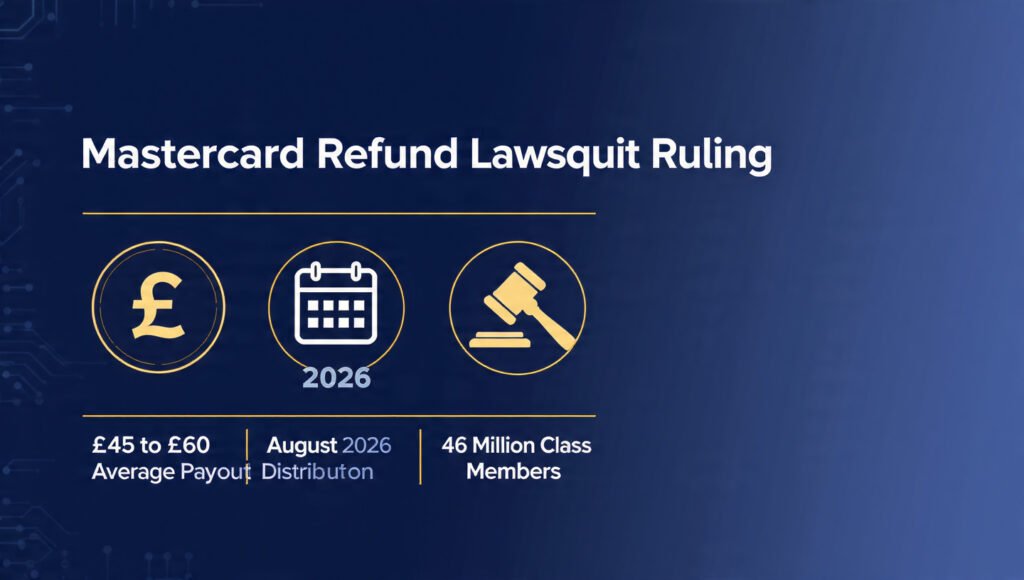
The Competition Appeal Tribunal issued its preliminary approval in January 2026. A final approval hearing followed in March 2026. Both rulings cleared the path for the claims administrator to begin distributing funds.
The case is formally known as Walter Merricks v Mastercard Incorporated. It was filed under the Consumer Rights Act 2015, a law that allowed opt-out class actions in the U.K. for the first time. The ruling means Mastercard accepted liability without admitting wrongdoing. The settlement fund will compensate roughly 46 million consumers.
Key Takeaway: The 2026 ruling is final and binding. Mastercard will pay. The only remaining step is distribution, which starts later this year.
Merricks v Mastercard Settlement: What It Means for Consumers
Walter Merricks, a former chief financial ombudsman, brought the claim on behalf of every U.K. consumer who used Mastercard during the relevant period. You do not need to have kept receipts or card statements. The settlement is opt-out, meaning you are automatically included.
This matters because older refund models required individual proof of loss. Merricks argued successfully that Mastercard’s interchange fees inflated prices across the entire retail economy. The tribunal agreed that the harm was systemic and measurable through economic modeling.
For consumers, this means you will receive a payment without needing to submit detailed documentation. Your eligibility is based on Mastercard’s own transaction records and demographic data used by the claims administrator. You simply need to confirm your identity and provide current bank details if contacted.
The settlement fund covers everyone who was a U.K. resident, aged 16 or older, and used a Mastercard product between May 1992 and June 2008. Millions of people have already moved, changed banks, or passed away. The administrator is working through address tracing to locate all class members.
Mastercard Interchange Fee Lawsuit History and Why It Matters
The interchange fee lawsuit began with a European Commission ruling in 2007. The Commission found that Mastercard’s multilateral interchange fees violated competition law by artificially raising costs for retailers. Those costs were passed on to consumers through higher prices.
Mastercard challenged that ruling for years. The European Court of Justice ultimately upheld the Commission’s decision in 2014. That judgment became the foundation for Merricks’ consumer claim.
He filed the collective action in 2016. The Competition Appeal Tribunal initially refused to certify the case. Merricks appealed. The Court of Appeal overturned the refusal. Mastercard then appealed to the U.K. Supreme Court, which ruled in Merricks’ favor in 2020. The Supreme Court decision lowered the bar for certifying opt-out class actions and is now a landmark ruling in U.K. law.
The case returned to the CAT for trial preparation. Settlement negotiations accelerated in late 2024 and concluded with the 2026 preliminary approval.
| Milestone | Date |
|---|---|
| European Commission Infringement Decision | December 2007 |
| European Court of Justice Upholds Decision | September 2014 |
| Merricks Files Collective Action | September 2016 |
| U.K. Supreme Court Rules in Merricks’ Favor | December 2020 |
| Settlement Agreement Reached | Late 2024 |
| Preliminary Approval Granted | January 2026 |
| Final Approval Hearing | March 2026 |
| Distribution Begins | Q3 2026 |
Key Takeaway: The case took nearly a decade because it redefined U.K. class action law. The Supreme Court’s 2020 ruling is the reason this settlement exists.
Mastercard Refund Lawsuit Who Qualifies
You qualify for a refund if you were a U.K. resident, aged 16 or older, and made at least one purchase with a Mastercard credit or debit card between May 22, 1992 and June 21, 2008.
The card did not need to be issued by a U.K. bank. You only needed to be living in the U.K. when you used it. Expats who lived in the U.K. during that period also qualify. The settlement covers purchases made in the U.K. only, not international transactions processed outside the country.
There is no minimum spend threshold. A single purchase during that 16-year window makes you an eligible class member. You do not need to prove the purchase with a receipt. The claims administrator uses statistical models and available transaction data to identify qualifying individuals.
Deceased class members are also covered. The estate or personal representative can claim on their behalf. The administrator has a separate process for estates that will be communicated through public notices in 2026.
Mastercard Class Action Eligibility Criteria
The specific criteria are straightforward but worth reading carefully. You must meet all three conditions.
First, you must have been alive and at least 16 years old during the class period. If you turned 16 in 2005, you are eligible for purchases made from your 16th birthday onward.
Second, you must have been ordinarily resident in the United Kingdom. This includes England, Scotland, Wales, and Northern Ireland. Temporary residents, students, and foreign nationals living in the U.K. all count.
Third, you must have used a Mastercard-branded card for a purchase in the U.K. The card type does not matter. Credit, debit, charge, prepaid, and corporate cards all qualify. The key factor is the Mastercard network processing the transaction.
| Criteria | Details |
|---|---|
| Age | 16 years or older during class period |
| Residency | U.K. resident at time of purchase |
| Card Type | Any Mastercard-branded card |
| Transaction Location | Purchase made within the United Kingdom |
| Class Period | May 22, 1992 to June 21, 2008 |
Key Takeaway: If you lived in the U.K. and swiped a Mastercard even once between 1992 and 2008, you are almost certainly a class member.
How Much Will I Get From Mastercard Settlement
The average payout per person will fall between £45 and £60, based on the final fund size and the number of validated claims.
The settlement fund is £197.5 million. After deducting legal fees, litigation funding costs, and administration expenses, the distributable amount drops to roughly £128 million to £140 million. The exact figure depends on final cost approvals by the tribunal.
The claims administrator expects roughly 25 million to 30 million verified claimants to receive payment. Not all 46 million eligible individuals will be located or will cash their checks.
The math works like this. If £135 million is distributed among 27 million verified claimants, the average payment lands around £50. That figure varies based on your estimated transaction volume during the class period. The distribution model weights payments toward people who likely made more purchases.
Mastercard Refund Average Payout Per Person
The £50 average figure is a midpoint. Some claimants will receive less, around £20 to £30. Others with higher estimated usage will see payments closer to £80 to £120. A small number of heavy card users may receive several hundred pounds.
The distribution formula uses a points system. Each year of U.K. residency during the class period counts. Estimated card usage frequency also factors in, derived from aggregate spending data matched to demographic profiles.
The administrator does not know your individual transactions unless you provide bank records. The model approximates usage based on age, income bracket, and geographic spending patterns from the 1990s and 2000s.
Think of it like a water bill split among tenants. Everyone pays a share based on estimated usage, not precise metering. Some pay more, some less, but everyone pays something. The Mastercard settlement uses the same logic. Your share reflects your likely slice of the total interchange overcharge.
Mastercard Settlement Payment Amounts Per Claimant in 2026
Here is the estimated payment breakdown based on the administrator’s distribution model.
| Claimant Profile | Estimated Payout Range |
|---|---|
| Minimal usage (one to five purchases) | £20 to £35 |
| Moderate usage (regular but not daily) | £45 to £65 |
| High usage (frequent cardholder) | £75 to £120 |
| Very high usage (daily primary card) | £130 to £300 plus |
These ranges are estimates. Final amounts will not be known until distribution begins.
Payments will be made via bank transfer for claimants who registered their details. Those who have not registered will receive a cheque mailed to the last known address on file. The administrator strongly encourages direct deposit registration to avoid delays.
The settlement covers the entire class period. If you used Mastercard only in 2007, you still receive something. The model accounts for partial periods.
Mastercard Refund Check Amount 2026: What to Expect
Your 2026 refund check will not make anyone rich. It is compensation for a systemic overcharge spread over 16 years. For most people, it is a modest sum, roughly the cost of a nice dinner for two.
The cheques will arrive in plain envelopes from the settlement administrator. The return address will reference the Merricks v Mastercard settlement. They will not require a signature upon delivery. The cheque will list the case name, the claim reference number, and the exact payment amount.
You have six months from the issue date to cash or deposit the cheque. After that window, uncashed funds return to the settlement fund for potential redistribution or cy-près distribution to consumer charities, as directed by the tribunal.
Claimants who provided bank details will receive faster payment. Direct deposits land about two to three weeks before physical cheques arrive. If you have not yet submitted bank information, the administrator’s portal remains open for updates.
Key Takeaway: Expect a modest payout. The real victory is the legal precedent, not the individual cheque amount.
Mastercard Settlement Payout Date 2026
Distribution will begin in the third quarter of 2026, with most payments landing between August and November.
The final approval hearing in March 2026 resolved any remaining objections. The tribunal then approved the administrator’s distribution plan in April. That triggered a 90-day preparation window for payment processing.
August 2026 is the target start date for the first wave of bank transfers. Cheque issuance follows in September. The administrator expects 70% of payments to complete by the end of October. The remaining 30% will involve complex cases, estate claims, and address verification challenges.
No payments will arrive before August 2026. Any message claiming otherwise is a scam. The administrator will never ask for payment to release your refund. Report phishing attempts to the official settlement contact line.
When Will I Receive My Mastercard Refund
Your refund timing depends on how you registered and when your identity is verified.
Claimants who completed the online registration portal and provided bank details in 2025 will be in the first payment batch. Those individuals should see funds in August or early September 2026. Claimants who registered but selected cheque delivery will receive payment by late September or October.
Unregistered class members whom the administrator identifies through address tracing will receive outreach letters starting in June 2026. Those letters include a verification code and instructions for claiming the payment. Responding quickly keeps you in the main distribution window. Delaying pushes your payment into late 2026 or early 2027.
Estate claims will take the longest. The administrator must validate the executor’s authority and confirm the deceased’s eligibility. Estate payments may not arrive until the first quarter of 2027.
Mastercard Refund Distribution Schedule for 2026
Here is the complete distribution timeline.
| Phase | Date | Details |
|---|---|---|
| Final Approval | March 2026 | Tribunal confirms settlement |
| Distribution Plan Approval | April 2026 | Administrator submits payment logistics |
| Verification Period | May to July 2026 | Identity checks and address tracing |
| First Wave Bank Transfers | August 2026 | Direct deposit to registered claimants |
| Cheque Issuance Begins | September 2026 | Mailed to confirmed addresses |
| Outreach to Unregistered Claimants | June to September 2026 | Letters with verification codes |
| Second Wave Payments | October to November 2026 | Late verifications and reissued payments |
| Estate Payments | Q4 2026 to Q1 2027 | Complex validations processed |
| Unclaimed Funds Deadline | Mid-2027 | Unclaimed cheques expire after 6 months |
Key Takeaway: Most people who registered will see money by October 2026. If you have not registered, expect outreach in mid-2026.
How to File Mastercard Settlement Claim (If You Haven’t Yet)
The main claim registration window closed in late 2025. However, the administrator is still accepting late registrations through the official portal. You will need to provide your full name, date of birth, U.K. residential addresses during the class period, and current contact information.
Visit the settlement administrator’s website to begin. The portal asks for address history from 1992 to 2008. Do your best to reconstruct this information. Even partial address history helps the verification process.
You will need an email address and a U.K. bank account for direct deposit. If you live abroad now, you can still claim. Provide your current international address and a valid bank account that accepts international transfers.
The administrator does not require scanned receipts or bank statements from the 1990s. The evidentiary burden is intentionally low. The opt-out model means the administrator attempts to find and pay everyone, not just those with perfect records.
Mastercard Settlement Administrator Contact and Claim Status
The court-appointed administrator is managing all claimant communications, verification, and payments. The contact channels are monitored and responsive.
Phone support operates during U.K. business hours. Email inquiries receive a response within three to five business days. The online portal includes a claim status checker where you can see whether your registration is complete, pending verification, or approved for payment.
Do not contact Mastercard directly. They will redirect you to the administrator. Do not contact the tribunal. Court staff cannot provide individual claim updates.
| Contact Method | Details |
|---|---|
| Online Portal | Settlement administrator website (search Merricks v Mastercard settlement) |
| Phone | U.K. freephone number published on the portal |
| Contact form available on the administrator site | |
| Administrator’s London office (address on portal) |
Key Takeaway: Use the online portal. It is the fastest way to check status, update details, and get questions answered.
Mastercard Refund Claim Deadline 2026
The original registration deadline passed in late 2025. A secondary deadline for late registrations and address updates is expected to fall in September 2026.
The tribunal set the original cut-off to allow the administrator enough time to verify claims before distribution. Late registrations will still be processed, but payments may be delayed. If the secondary deadline passes, unregistered claimants will need to wait for unclaimed fund redistribution procedures, which could take years.
If you receive an outreach letter in 2026, respond immediately. Those letters have individualized deadlines, typically 60 days from the mailing date. Missing that window significantly complicates your claim.
Estates face the same deadlines. Executors should register as soon as they become aware of the settlement. The administrator cannot accept estate claims after the final distribution order is issued, expected in late 2027.
Mastercard Class Action Final Approval Hearing Update
The final approval hearing took place in March 2026 at the Competition Appeal Tribunal in London. The tribunal reviewed the settlement terms, legal fee requests, and the distribution plan. No material objections were raised. The settlement was approved in full.
The tribunal also approved the litigation funding repayment. Innsworth Litigation Funding, which financed the case for nearly a decade, will receive a court-approved portion of the settlement fund. The exact percentage remains under a confidentiality order but is estimated between 25% and 35% of the gross fund.
Class representative Walter Merricks will receive a modest honorarium for his role, a standard practice in U.K. collective proceedings. The amount was approved by the tribunal and disclosed in the final order.
The approval order is public. It can be viewed on the tribunal’s website or through the settlement administrator’s document library. The order confirms the settlement is binding on all class members who did not opt out during the notice period in 2024.
Frequently Asked Questions
Is the Mastercard refund lawsuit settlement real?
Yes, the Merricks v Mastercard settlement is a real, court-approved resolution.
It was approved by the U.K. Competition Appeal Tribunal in March 2026.
Payments to eligible consumers begin in August 2026.
How do I know if I am part of the Merricks v Mastercard settlement?
You are automatically included if you lived in the U.K. and used Mastercard between 1992 and 2008.
No opt-in was required. The settlement is an opt-out proceeding.
Check the administrator’s portal if you are unsure or need to update your contact details.
What documents do I need to prove my Mastercard usage from 1992 to 2008?
You do not need to provide transaction receipts or old bank statements.
The administrator uses statistical modeling and available data to verify eligibility.
You only need to confirm your identity and U.K. address history.
Will my Mastercard settlement payment be taxed?
In the United Kingdom, compensation payments from class action settlements are generally not subject to income tax.
Capital gains or inheritance tax implications could arise in specific limited circumstances.
Tax rules vary by country. International recipients should confirm local treatment.
Can I still join the Mastercard class action if I missed the deadline?
You cannot opt in late if you were not previously a class member.
All U.K. residents who used Mastercard during the class period are automatically members.
If you missed the registration window, respond immediately to any outreach letter or contact the administrator.
The 2026 Mastercard refund settlement is a done deal. If you lived in the U.K. and used Mastercard between 1992 and 2008, money is coming your way. Most people will see payments between August and October of this year. The amounts are modest but meaningful, and the process is designed to be as simple as possible. Check the settlement administrator’s portal today. Confirm your address and bank details. Do not let your payout sit unclaimed because of outdated contact information. This money belongs to you. Go get it.