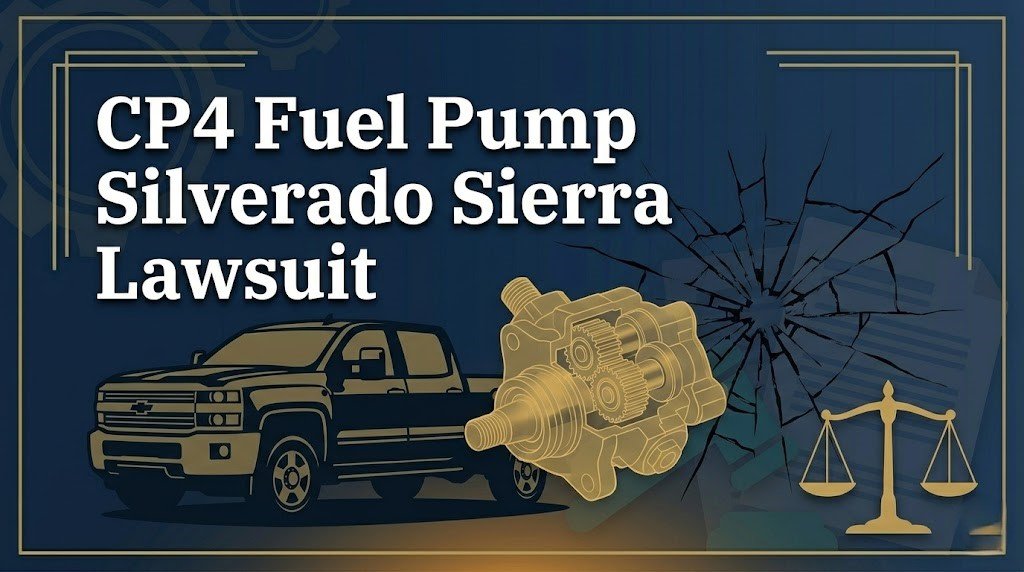
The CP4 fuel pump Silverado Sierra lawsuit is one of the biggest diesel truck legal battles heading into 2026. Thousands of Chevy Silverado and GMC Sierra owners have reported catastrophic Bosch CP4 fuel pump failures that destroy entire fuel systems. Repair bills often land between $8,000 and $15,000, and most owners had no warning before their trucks broke down.
This article breaks down everything you need to know for 2026. You’ll learn about estimated payouts, which truck models qualify, how to file a claim, and what the current settlement timeline looks like.
One detail that surprises most people: the CP4 pump was originally designed for European diesel fuel, which has better lubricity than American diesel. That design choice is at the heart of every lawsuit filed against GM and Bosch.
If you own a Duramax diesel truck, this guide will tell you exactly where things stand and what to do next.
CP4 Fuel Pump Silverado Sierra Lawsuit Overview
The CP4 fuel pump Silverado Sierra lawsuit is a collection of class action and individual lawsuits alleging that General Motors and Bosch sold trucks with a fundamentally flawed fuel pump. The Bosch CP4.2 high pressure fuel injection pump, installed in Duramax 6.6L diesel engines, is accused of self-destructing under normal operating conditions.
When the CP4 pump fails, metal shavings from the pump’s internals spread throughout the entire fuel system. This contaminates fuel lines, fuel injectors, the fuel rail, and sometimes the diesel particulate filter. The result is a complete fuel system replacement, not just a pump swap.
Lawsuits have been filed in multiple federal courts, including the U.S. District Court for the Eastern District of Michigan. Prominent law firms like Hagens Berman and Chimicles Schwartz Kriner & Donaldson-Smith represent plaintiff classes.
The core legal argument is straightforward: GM and Bosch knew the CP4 pump was designed for European diesel standards (EN 590), which require higher fuel lubricity than American ASTM D975 diesel fuel. Despite this mismatch, they installed the pump in hundreds of thousands of trucks sold in the United States.
| Detail | Info |
|---|---|
| Defendants | General Motors, Robert Bosch GmbH |
| Vehicles | Silverado 2500HD/3500HD, Sierra 2500HD/3500HD |
| Engine | Duramax 6.6L L5P (and earlier variants) |
| Core Allegation | CP4 pump designed for European diesel, fails on American fuel |
| Key Law Firms | Hagens Berman, Chimicles Schwartz Kriner |
CP4 Fuel Pump Class Action Settlement 2026
As of early 2026, a finalized, court-approved class action settlement for CP4 fuel pump claims has not been publicly confirmed. However, settlement negotiations between GM, Bosch, and plaintiff attorneys have been reported in court filings, and legal experts expect significant movement this year.
Several factors point toward a potential settlement in 2026. The sheer volume of complaints, numbering in the tens of thousands, makes continued litigation expensive for both sides. GM has faced mounting pressure from NHTSA complaints and negative publicity.
If a class action settlement is approved in 2026, it would likely cover repair reimbursement for owners who already paid out of pocket. It may also include extended warranty coverage for owners whose pumps have not yet failed.
Keep in mind that individual lawsuits are proceeding alongside class action claims. Some owners have chosen to file individual product liability cases seeking higher compensation than a class settlement would provide.
- Class action status: Active litigation, settlement talks reported
- Individual lawsuits: Proceeding in parallel in various state and federal courts
- Expected coverage: Repair reimbursement and extended warranty provisions
- Court jurisdiction: Multiple federal districts
CP4 Fuel Pump Lawsuit Update for 2026
The most important CP4 fuel pump lawsuit update for 2026 is that the litigation has matured past early procedural stages. Class certification motions have been filed, and discovery between parties is well underway.
In late 2025, several court orders moved the cases closer to trial-ready status. Depositions of GM engineers and Bosch product development executives have taken place. Internal documents showing what both companies knew about CP4 failure rates on American diesel have entered the court record.
Some consolidated cases are now in the multidistrict litigation (MDL) phase, which groups similar federal lawsuits for more efficient pre-trial proceedings. This is a strong signal that the courts recognize the widespread nature of the defect.
For 2026, truck owners should watch for these key developments:
- Class certification rulings that define exactly who qualifies
- Settlement conference dates ordered by presiding judges
- Any GM voluntary recall or warranty extension announcements
- Bellwether trial selections if settlement talks stall
Key Takeaway: The CP4 fuel pump lawsuit is not a distant possibility. It’s active litigation with real momentum heading into 2026, and owners who act now will be better positioned when a resolution arrives.
GM Duramax CP4 Lawsuit Payout Expectations
The GM Duramax CP4 lawsuit payout will likely vary based on whether the case resolves through a class action settlement or individual litigation. Class action payouts tend to be lower per person but reach more people. Individual verdicts can be significantly higher.
Based on typical product defect settlements of this scale and the documented repair costs, legal analysts project the following payout ranges for a class action resolution:
| Claim Type | Estimated Payout Range |
|---|---|
| Full fuel system replacement (with receipts) | $6,000 to $12,000 |
| Partial repair (pump only, with receipts) | $2,500 to $5,000 |
| Owners with no failure yet (warranty extension) | Extended warranty coverage, 7 to 10 years |
| Individual lawsuit verdict/settlement | $10,000 to $25,000+ |
These are projections based on repair cost data and comparable automotive defect settlements. The actual numbers will depend on the final terms negotiated between the parties and approved by the court.
Owners who kept detailed repair records stand to recover the most. Those who paid dealership prices for a full fuel system flush and component replacement could see reimbursement covering most or all of their out-of-pocket costs.
The total settlement fund size is another variable. If GM agrees to a $500 million fund (a reasonable estimate given the scope), individual payouts will depend on how many valid claims are filed.
How Much Can You Get from the CP4 Fuel Pump Lawsuit
How much you can get from the CP4 fuel pump lawsuit depends on three factors: your documented repair costs, whether you file a class action claim or individual lawsuit, and the tier system the settlement uses.
Most class action settlements create payment tiers. Owners who spent more on repairs and have better documentation receive higher payouts. Here’s what that might look like:
Tier 1: Full System Replacement
You replaced the CP4 pump, all fuel injectors, fuel lines, fuel rail, and had a complete system flush. You have dealer or shop invoices. Estimated recovery: $8,000 to $12,000.
Tier 2: Partial Repair
You replaced the CP4 pump and some components but not the entire system. You have partial documentation. Estimated recovery: $3,000 to $6,000.
Tier 3: No Failure Yet
Your truck has a CP4 pump but it hasn’t failed. You could receive an extended warranty or a voucher toward future repairs. Estimated value: $500 to $2,000 in warranty coverage.
Think of it like insurance claim tiers. The more damage you can prove, the more you receive. That’s why documentation matters so much.
Owners who pursue individual lawsuits outside the class action can potentially recover more, especially if they can show consequential damages like lost income from a work truck being down for weeks.
CP4 Fuel Pump Settlement Eligibility Requirements
CP4 fuel pump settlement eligibility is based on owning or leasing a qualifying GM diesel truck equipped with the Bosch CP4.2 fuel pump. You don’t need to have experienced a pump failure to be part of the class, but your payout amount will differ based on whether you’ve had a failure and repair.
Basic eligibility requirements expected for 2026:
- You owned or leased a Chevrolet Silverado 2500HD or 3500HD with a Duramax diesel engine
- You owned or leased a GMC Sierra 2500HD or 3500HD with a Duramax diesel engine
- Your truck was equipped with the Bosch CP4.2 high pressure fuel pump
- Your vehicle falls within the affected model years (generally 2011 to 2024)
- You purchased or leased the vehicle in the United States
| Eligibility Factor | Requirement |
|---|---|
| Vehicle | Silverado 2500HD/3500HD or Sierra 2500HD/3500HD |
| Engine | Duramax 6.6L diesel with CP4.2 pump |
| Model Years | 2011 to 2024 (may vary by specific case) |
| Purchase Location | United States |
| Failure Required? | No, but affects payout tier |
| Documentation Needed | Repair invoices, purchase records, VIN |
People who bought their trucks used are generally still eligible. The defect runs with the vehicle, not the original buyer. If you’re the second or third owner and your CP4 pump failed, you should still qualify.
Key Takeaway: You don’t need to wait for your CP4 pump to fail before you’re eligible. Owning or leasing an affected model year Duramax truck is enough to be part of the class, though actual pump failure with documented repairs means a bigger payout.
Which Silverado and Sierra Models Have the CP4 Pump
The Bosch CP4.2 fuel pump was installed in Chevrolet Silverado and GMC Sierra heavy-duty trucks with the Duramax 6.6L diesel engine starting with the 2011 model year. It replaced the older, more reliable Bosch CP3 pump that was used in earlier Duramax engines.
Confirmed affected models include:
- Chevrolet Silverado 2500HD (2011 to 2024)
- Chevrolet Silverado 3500HD (2011 to 2024)
- GMC Sierra 2500HD (2011 to 2024)
- GMC Sierra 3500HD (2011 to 2024)
The CP4 pump was used across multiple Duramax engine generations:
| Engine Code | Years | CP4 Pump? |
|---|---|---|
| LML Duramax 6.6L | 2011 to 2016 | Yes |
| L5P Duramax 6.6L | 2017 to 2024 | Yes |
| LBZ Duramax 6.6L | 2006 to 2007 | No (uses CP3) |
| LMM Duramax 6.6L | 2007 to 2010 | No (uses CP3) |
The easiest way to check if your truck has a CP4 pump is to look at your build sheet or VIN decode. Any Duramax diesel Silverado or Sierra from 2011 forward has one. Trucks built before 2011 used the CP3 pump and are not affected.
Some owners of affected trucks have proactively converted from CP4 to CP3 pumps using aftermarket kits. Those owners may still qualify for the lawsuit based on the original defect, but their payout structure could differ.
CP4 Fuel Pump Failure Symptoms to Watch For
CP4 fuel pump failure symptoms typically appear suddenly and without much warning. The most common first sign is your truck going into limp mode or stalling completely, often while driving at highway speeds.
Watch for these symptoms:
- Check engine light illuminates with fuel pressure codes (P0087, P228D)
- Engine stalling or rough idle that worsens rapidly
- Limp mode activation where the truck limits power to protect the engine
- Hard starting or extended cranking before the engine fires
- Metallic debris visible in the fuel filter during routine changes
- Loss of power under acceleration or when towing
The scary part about CP4 failures is how fast they escalate. The pump’s internal components, particularly the roller bearings, can disintegrate within minutes. Once metal shavings enter the high pressure common rail system, the contamination spreads everywhere.
Think of it like sugar in a gas tank, except the “sugar” is steel fragments being pushed through precision fuel injectors at 30,000+ PSI. Nothing downstream survives.
Some owners report catching early warnings by performing frequent fuel filter inspections. If you see any metallic shimmer or particles in your fuel filter, that’s a red flag. Stop driving the truck immediately and have it towed. Continuing to drive with a failing CP4 pump dramatically increases repair costs.
CP4 Fuel Pump Repair Cost Without a Settlement
CP4 fuel pump repair cost without a settlement or warranty coverage typically ranges from $8,000 to $15,000 at a dealership. Independent diesel shops may charge $5,000 to $10,000 depending on the extent of contamination.
Here’s why the bill is so high. A CP4 failure doesn’t just kill the pump. It contaminates the entire fuel delivery system.
| Component | Estimated Repair Cost |
|---|---|
| Bosch CP4 pump replacement | $2,000 to $3,500 |
| Fuel injectors (all 8) | $3,000 to $5,000 |
| Fuel rails and lines | $800 to $1,500 |
| Fuel system flush | $500 to $1,000 |
| Fuel tank cleaning/replacement | $300 to $800 |
| Labor (10 to 20+ hours) | $1,500 to $3,000 |
| Total Range | $8,000 to $15,000 |
Compare that to a CP3 pump replacement on an older Duramax, which typically costs around $2,000 to $3,000 total. The CP4’s failure mode is what makes it so expensive. The CP3 pump rarely sends debris downstream when it fails.
Many owners report that GM dealers initially quoted them the full price without offering goodwill assistance. Some owners received partial warranty coverage through GM’s customer assistance programs, but those offers were inconsistent and often covered less than half the bill.
This is exactly the kind of out-of-pocket cost that the lawsuit aims to recover. Every receipt you kept from your CP4 repair becomes evidence of your damages.
Key Takeaway: CP4 fuel pump repairs cost $8,000 to $15,000 because the failure contaminates the entire fuel system, and every dollar you can document through repair receipts directly supports a higher claim payout.
Bosch CP4 Pump Defect Lawsuit Explained
The Bosch CP4 pump defect lawsuit targets Bosch as the manufacturer of the faulty pump alongside GM as the company that chose to install it. Bosch designed the CP4.2 pump primarily for European diesel markets, where fuel lubricity standards are significantly higher.
European diesel fuel meets EN 590 standards, which require a minimum lubricity level measured by the HFRR (High Frequency Reciprocating Rig) test of 460 microns or less. American diesel fuel under ASTM D975 has a more lenient standard of 520 microns. That 60-micron difference matters enormously for a pump with tight metal-on-metal tolerances.
The CP4 pump relies on fuel as its primary lubricant. When American diesel doesn’t provide enough lubricity, the pump’s internal roller bearings grind against their cam ring. Over time, or sometimes very quickly, this causes catastrophic internal wear.
Key allegations against Bosch:
- Designed the CP4 for fuel standards that don’t exist in the U.S. market
- Failed to adequately warn GM about the pump’s sensitivity to lower-lubricity fuel
- Continued selling the pump despite knowledge of widespread failure reports
- Did not redesign the pump for American fuel specifications
Bosch has faced similar lawsuits related to CP4 failures in Ford Power Stroke and Ram Cummins diesel trucks. The defect is not unique to GM vehicles, but the Silverado and Sierra represent the largest volume of affected trucks.
Who Is Responsible for CP4 Pump Failure: GM or Bosch
Both GM and Bosch share responsibility for CP4 pump failures, and lawsuits name both companies as defendants. The legal arguments against each company are slightly different.
The case against GM:
- GM selected the CP4 pump knowing it was designed for European diesel
- GM had the engineering resources to test the pump on American fuel
- GM received warranty claims and complaints but continued using the CP4
- GM chose the CP4 over the more reliable CP3 to save money and improve fuel economy
The case against Bosch:
- Bosch manufactured a pump with design tolerances too tight for U.S. fuel
- Bosch sold the pump to GM without adequate warnings about fuel quality requirements
- Bosch had failure data from other vehicle manufacturers using the CP4
| Responsibility Factor | GM | Bosch |
|---|---|---|
| Selected the pump for U.S. trucks | Yes | No |
| Designed the pump | No | Yes |
| Tested for U.S. fuel compatibility | Should have | Should have |
| Received failure complaints | Yes | Yes |
| Continued selling/using despite complaints | Yes | Yes |
From a legal perspective, this shared liability actually benefits truck owners. Having two deep-pocketed defendants increases the total recovery pool. If one company settles and the other goes to trial, plaintiffs can potentially collect from both.
The jury is still out, literally, on which company bears more blame. But the practical effect for truck owners is the same: your damaged fuel system needs to be paid for, and both companies have the resources to cover it.
How to File a CP4 Fuel Pump Lawsuit Claim
Filing a CP4 fuel pump lawsuit claim in 2026 involves either joining the existing class action or pursuing an individual lawsuit. For most owners, joining the class action is the simpler and more cost-effective path.
Steps to join the class action:
- Confirm your vehicle qualifies. Check your VIN to verify you have a 2011 to 2024 Silverado or Sierra with a Duramax diesel engine.
- Gather your documentation. Collect all repair invoices, dealer service records, warranty claim paperwork, and photos of the failed pump or contaminated fuel.
- Contact the class action law firm. Firms like Hagens Berman have online intake forms specifically for CP4 claims. You’ll provide your VIN, contact info, and repair details.
- Wait for class certification. Once the court certifies the class, you’ll receive official notice by mail or email explaining your options.
- Submit your claim. When a settlement is approved, the settlement administrator will provide a claim form. Fill it out completely with all supporting documents.
There’s no upfront cost to join most class actions. Plaintiff law firms work on contingency, meaning they take a percentage of the settlement rather than billing you hourly.
If your damages exceed what a class action would pay, typically when your repair bill topped $10,000 or you lost significant income due to truck downtime, an individual lawsuit might make more sense. Individual cases require more involvement from you but can yield higher recoveries.
Key Takeaway: Filing a CP4 claim is free for class action participants, and the process starts with verifying your VIN and collecting your repair records. Don’t wait until a settlement is announced; get your paperwork organized now.
CP4 Fuel Pump Lawsuit Proof and Repair Documentation
The single most important thing you can do for your CP4 fuel pump lawsuit claim is preserve every piece of repair documentation. Your payout directly correlates to what you can prove you spent.
Documents to collect and keep safe:
- Dealer or shop repair invoices showing itemized parts and labor for CP4-related repairs
- Parts receipts for the pump, injectors, fuel lines, and any fuel system components
- Tow truck receipts if your truck was towed after a breakdown
- Rental car or loaner vehicle receipts for transportation costs during repair
- Photos of the failed pump and any metal debris found in the fuel system
- GM warranty claim records including any partial goodwill payments
- Service history printout from the dealership showing all Duramax-related maintenance
- Vehicle purchase agreement proving you owned or leased the truck
If you’ve already done repairs but threw away some receipts, contact your dealer or repair shop. Most shops can reprint invoices from their computer systems going back several years. Dealerships maintain detailed service records tied to your VIN.
| Document Type | Why It Matters |
|---|---|
| Itemized repair invoice | Proves exact out-of-pocket cost |
| Parts receipts | Confirms CP4-related components were replaced |
| Tow receipt | Shows consequential damages beyond the repair itself |
| Photos of failed pump | Visual evidence of the defect |
| Purchase agreement | Proves ownership during the affected period |
Credit card and bank statements can serve as backup proof if original invoices are unavailable. Any record showing you paid for a fuel system repair on a qualifying truck has value.
Duramax Diesel CP4 Pump Recall Status
As of early 2026, there is no formal NHTSA safety recall for the Bosch CP4.2 fuel pump in Duramax diesel trucks. GM has not issued a voluntary recall either, despite thousands of complaints filed with both NHTSA and the company directly.
This lack of a recall is actually one of the strongest arguments in the lawsuit. Plaintiffs allege that GM’s refusal to issue a recall, despite knowing about the defect, shows the company prioritized profits over customer safety.
NHTSA has received thousands of complaints about CP4 failures in Silverado and Sierra trucks. The agency has opened preliminary evaluations at various points, but none have escalated to a formal recall order as of this writing.
Why no recall?
- GM argues that CP4 failures are not a safety defect because they cause the engine to lose power gradually rather than suddenly
- Bosch has not acknowledged a manufacturing defect
- A recall would cost GM and Bosch hundreds of millions in parts and labor
- NHTSA’s bar for ordering a recall is high, typically requiring evidence of a crash risk
Some truck owners have reported engine stalls at highway speeds, which clearly presents a safety hazard. Those incidents are documented in NHTSA complaint records and serve as evidence in the lawsuit.
The absence of a recall doesn’t prevent you from filing a lawsuit claim. Class action and individual lawsuits proceed independently of the recall process.
GM CP4 Settlement Timeline for 2026
The GM CP4 settlement timeline for 2026 is likely to include several major milestones, though exact dates depend on court scheduling and negotiation progress.
| Timeline Phase | Expected Timing |
|---|---|
| Ongoing discovery and depositions | Q1 2026 |
| Class certification rulings | Q1 to Q2 2026 |
| Settlement conference or mediation | Q2 to Q3 2026 |
| Preliminary settlement approval (if reached) | Q3 to Q4 2026 |
| Notice to class members | 30 to 60 days after preliminary approval |
| Objection and opt-out period | 60 to 90 days after notice |
| Final approval hearing | 90 to 120 days after preliminary approval |
| Claim filing window opens | After final approval |
| First payouts distributed | 6 to 12 months after final approval |
If settlement talks succeed in mid-2026, the earliest payouts could arrive in late 2026 or early 2027. That’s the optimistic scenario.
If talks fail and the case proceeds to trial, the timeline stretches significantly. A trial verdict wouldn’t come until 2027 or later, and appeals could push final resolution into 2028.
There’s a middle-ground scenario worth considering. GM might offer a voluntary warranty extension or repair reimbursement program outside of the formal settlement to reduce the class size and its legal exposure. Ford did something similar with its own CP4 pump issues in Power Stroke diesel trucks.
Patience matters here, but so does preparation. The owners who file claims quickly and with complete documentation will receive payouts first once the process begins.
Key Takeaway: A realistic CP4 settlement timeline suggests preliminary approval could come in late 2026, with actual payouts arriving in late 2026 or early 2027 if negotiations succeed this year.
CP4 Fuel Pump Settlement Tax Implications
CP4 fuel pump settlement proceeds for repair reimbursement are generally not taxable income under IRS rules. That’s the good news for truck owners expecting a payout.
The IRS treats settlement payments differently depending on what they compensate you for. Reimbursement for property damage, which is what a fuel system repair qualifies as, is typically not taxable as long as the payment doesn’t exceed your actual repair costs.
Here’s how it breaks down:
| Payment Type | Taxable? |
|---|---|
| Reimbursement for out-of-pocket repair costs | Generally no |
| Payment exceeding actual repair costs | Potentially yes (treated as gain) |
| Punitive damages (if awarded in individual case) | Yes, fully taxable |
| Interest on delayed payment | Yes, taxable as interest income |
| Lost income compensation (work truck downtime) | Yes, taxable as ordinary income |
If you receive exactly what you spent on repairs, you’re essentially being made whole. The IRS doesn’t consider that a gain. But if the settlement pays you $12,000 and your actual repair bill was $8,000, that extra $4,000 could be taxable.
One often-overlooked detail: the settlement administrator will likely issue a 1099 form to claimants receiving payments above $600. Even if the money isn’t taxable, you may need to report it on your tax return and then exclude it using the appropriate IRS provisions.
Keep your repair receipts paired with your settlement payment records. Your tax preparer will need both to properly handle the reporting.
CP4 Fuel Pump Settlement Funding Options
CP4 fuel pump settlement funding, sometimes called pre-settlement funding or lawsuit lending, is an option for truck owners who already paid thousands for repairs and can’t wait months or years for a settlement payout.
Pre-settlement funding companies advance you money based on the expected value of your pending legal claim. You repay the advance from your settlement proceeds. If you don’t win or settle, most funding companies don’t require repayment.
How pre-settlement funding works for CP4 claims:
- You apply with a funding company and provide your case details
- The company evaluates your claim’s strength and expected payout
- If approved, you receive a cash advance, typically 10% to 20% of the expected settlement
- When you receive your settlement, the funding company takes their advance plus fees
- If the case is lost, you owe nothing (non-recourse funding)
| Funding Detail | Typical Terms |
|---|---|
| Advance amount | $1,000 to $5,000 |
| Funding fee/interest | 2% to 4% per month (varies by company) |
| Repayment source | Your settlement proceeds |
| If case is lost | No repayment required |
| Approval time | 24 to 72 hours |
There are real costs to consider. Funding fees add up quickly. A $3,000 advance at 3% monthly interest over 18 months would cost you roughly $1,620 in fees. That’s a significant chunk of your eventual settlement.
Pre-settlement funding makes the most sense if you’re facing genuine financial hardship because your work truck was down and you lost income. For most owners who have already paid for repairs and can wait, it’s usually better to avoid the fees and wait for the full settlement payout.
Frequently Asked Questions
Is there a class action lawsuit for CP4 fuel pump failures in Silverado and Sierra trucks?
Yes, multiple class action lawsuits have been filed against General Motors and Bosch over defective CP4 fuel pumps in Duramax diesel Silverado and Sierra trucks.
Cases are active in several federal courts as of 2026.
The lawsuits seek repair reimbursement and extended warranty coverage for affected owners.
How much money can I get from the CP4 fuel pump lawsuit in 2026?
Estimated payouts range from $2,500 to $12,000 for class action claims depending on your repair costs and documentation.
Individual lawsuits can yield $10,000 to $25,000 or more.
Owners who kept detailed repair invoices will receive the highest tier payouts.
What model years of Silverado and Sierra are affected by the CP4 pump defect?
The affected model years are 2011 to 2024 for both Chevrolet Silverado 2500HD/3500HD and GMC Sierra 2500HD/3500HD with Duramax 6.6L diesel engines.
Earlier Duramax trucks (2010 and older) used the CP3 pump and are not affected.
Both new and used vehicle purchasers within those model years are eligible.
Do I need repair receipts to file a CP4 fuel pump lawsuit claim?
Repair receipts significantly strengthen your claim and determine your payout tier.
Without receipts, you may still qualify but will likely receive a lower-tier payment.
Contact your dealer or repair shop to request duplicate invoices if you’ve lost the originals.
Will my CP4 fuel pump settlement payout be taxed by the IRS?
Settlement payments that reimburse your actual out-of-pocket repair costs are generally not taxable.
Any amount exceeding your documented repair costs could be treated as taxable income.
Keep your repair receipts alongside your settlement payment records for accurate tax reporting.
The CP4 fuel pump lawsuit is heading toward a critical stage in 2026. If you own or ever owned a Duramax diesel Silverado or Sierra from 2011 to 2024, now is the time to act.
Gather your repair records, verify your VIN, and connect with the class action attorneys handling these cases. The preparation you do today directly affects how much you recover tomorrow.
Don’t sit on the sidelines while deadlines approach. Your documentation is your strongest weapon in this fight.