
Lawsuit loan companies are not actually lenders in the traditional sense. They are specialty finance firms that buy a piece of your future settlement in exchange for immediate cash. The legal term is non-recourse funding. If you lose your case, you owe them nothing. That is the tradeoff for the high fees.
The industry has exploded over the past decade. In 2024, the American Legal Finance Association estimated the U.S. pre-settlement funding market exceeded $15 billion annually. By 2026, that number is projected to top $18 billion as more plaintiffs learn about the option and more funders enter the space.
Not all companies operate the same way. Some focus exclusively on personal injury cases. Others take on employment discrimination claims, whistleblower cases, or even divorce settlement advances. A few specialize in post-settlement funding, where the case is already won but the check has not arrived yet. Those advances cost much less because the risk to the funder is near zero.
The key distinction for 2026 is between direct funders and brokers. Direct funders use their own capital to advance you cash. Brokers shop your case to multiple funders and take a commission. Dealing with a direct funder almost always results in lower total cost because you avoid the broker’s markup.
Here is a quick breakdown of the types you will encounter in 2026:
| Company Type | What They Do | Best For |
|---|---|---|
| Direct Funder | Uses own capital to fund your advance | Lower fees, faster decisions |
| Broker | Shops your case to multiple funders | Hard-to-fund cases |
| Post-Settlement Funder | Advances cash on already-won cases | Lowest rates, zero risk to you |
| Specialized Funder | Focuses on one area like workers comp | Niche case types |
Always ask the first person you speak with whether they are a direct funder or a broker. If they will not give a straight answer, hang up. That is a red flag.
Lawsuit Loan Rates
Lawsuit loan rates in 2026 land between 2 percent and 5 percent monthly, calculated either as simple or compound interest. That range sounds tight. The cost difference between the low end and the high end is staggering.
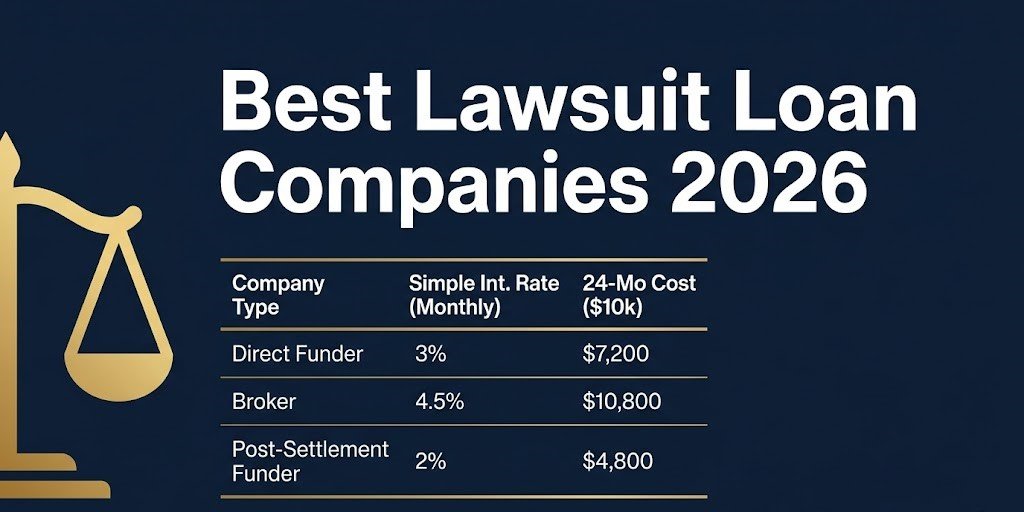
Simple interest means you pay the fee percentage only on the original advance amount. A $5,000 advance at 3 percent simple interest over 12 months costs $1,800 in fees. You repay $6,800 total.
Compound interest means the fee is calculated on the growing balance each month. That same $5,000 advance at 3 percent compounded monthly over 12 months costs $2,128 in fees. You repay $7,128 total.
The gap widens the longer your case takes. At 24 months, the simple interest deal costs $3,600 in fees. The compound deal costs $5,087. You pay nearly $1,500 more for the exact same advance from the exact same starting rate.
Here is the 2026 math on a standard $10,000 advance:
| Rate Type | Monthly Rate | 12-Month Cost | 24-Month Cost |
|---|---|---|---|
| Simple Interest | 3.0% | $13,600 | $17,200 |
| Compound Interest | 3.0% | $14,257 | $20,323 |
| Simple Interest | 4.5% | $15,400 | $20,800 |
| Compound Interest | 4.5% | $16,958 | $28,756 |
The numbers do not lie. A compound interest deal at 4.5 percent over two years costs nearly $29,000 on a $10,000 advance. That is the kind of math that wipes out your entire settlement.
Ask three questions before you sign: Is this simple or compound interest? What is the total repayment cap? Can you show me the math on a 24-month scenario?
Key Takeaway: Simple interest and rate caps are the only things standing between you and a financial disaster. Never sign a compound interest lawsuit loan contract.
How to Get a Lawsuit Loan
Getting a lawsuit loan in 2026 takes three steps and usually wraps up within 24 to 72 hours. The process moves fast because the funder only cares about one thing: the strength of your underlying case. Your credit score, job status, and income do not matter at all.
The first step is contacting the funding company directly or submitting an online application. Most applications ask for your name, phone number, the type of case you have, and your attorney’s contact information. That is it. No tax returns. No pay stubs. No bank statements.
The second step is where the real evaluation happens. The funder contacts your attorney and requests case documents. Those typically include the police report or incident report, medical records, demand letters, deposition transcripts if available, and any settlement offers already on the table. Your attorney must cooperate. No funding company will advance you a dime without your lawyer providing the case file.
The third step is the underwriting decision. The funder’s legal team reviews your case and estimates two things: how likely you are to win or settle, and how much the settlement is likely to be. They advance between 10 and 20 percent of that estimated settlement value. If they think your case is worth $100,000, you might get $10,000 to $20,000. If they think it is worth $30,000, you might get $3,000 to $6,000.
Once approved, you sign a funding agreement and the money hits your bank account, usually by ACH transfer, within one business day. Some companies offer same-day wire transfers for an additional small fee.
The entire process from first contact to cash in hand rarely takes longer than three business days for straightforward personal injury cases. Complex cases with multiple defendants or uncertain liability may take a week.
Lawsuit Loan Eligibility
Lawsuit loan eligibility in 2026 comes down to two things and two things only. You must have an active pending lawsuit or settled case awaiting payout. You must have an attorney representing you on contingency.
There is no credit check. No income verification. No asset review. The funding company does not care if you filed bankruptcy last year. They do not care if you are unemployed. They are not lending you money in the traditional sense. They are purchasing an interest in an asset that already exists: your lawsuit.
The type of case matters a great deal. Funders prefer cases with clear liability, significant damages, and a defendant with deep pockets. Insurance companies make excellent defendants because they actually pay claims. An uninsured driver who hit you while you were crossing the street makes a terrible defendant because there is nothing to collect even if you win.
Here is what most funders will and will not consider in 2026:
| Case Type | Typically Funded | Notes |
|---|---|---|
| Auto Accident | Yes | Most common funded case type |
| Slip and Fall | Sometimes | Depends on liability clarity |
| Medical Malpractice | Rarely | Very expensive to litigate, uncertain outcomes |
| Workers Compensation | Select funders only | Nova Legal Funding is the go-to here |
| Product Liability | Yes, if mass tort | Must be part of larger litigation |
| Employment Discrimination | Sometimes | Must show strong evidence |
| Wrongful Death | Yes | Higher advance amounts possible |
| Police Brutality | Sometimes | Depends on bodycam evidence |
Your attorney’s cooperation is also part of eligibility. If your lawyer refuses to provide case documents or discourages you from seeking funding, the funder will walk away. Some attorneys dislike pre-settlement funding because it reduces your final take-home amount and complicates settlement negotiations. Others view it as a necessary tool to keep a client financially stable while they fight for maximum compensation.
Key Takeaway: If you have a lawyer, a pending case with clear liability, and a defendant with insurance, you likely qualify for a lawsuit loan regardless of your personal finances.
Lawsuit Loan Application Process
The lawsuit loan application process starts with a five-minute form and ends with a funding decision driven entirely by your case file. You never need to prove your personal financial situation.
Most applications in 2026 live online. You enter your name, phone number, email, case type, and your attorney’s name and phone number. Some applications include a brief description box where you can summarize what happened. A short description helps the funder route your application to the right underwriter.
After you submit the form, an intake specialist calls or texts you, usually within an hour during business hours. They confirm your details and ask a few basic questions: When did the incident happen? Are you still treating for injuries? Has the defendant made any settlement offers? Have you applied for funding elsewhere?
Then the funder reaches out to your attorney. This is the step that determines everything. The funder requests your case file, which typically includes the complaint filed with the court, police or incident reports, medical records documenting your injuries, insurance policy limits, and any settlement demand letters exchanged.
An underwriter reviews the file and makes a funding decision within 24 to 48 hours for most auto accident and premises liability cases. The underwriter calculates an estimated case value and an estimated probability of success. You receive an offer that represents 10 to 20 percent of that estimated value.
If you accept the offer, you sign a funding agreement. The money arrives by ACH transfer the next business day. Some funders offer same-day wire service for a small fee, usually around $25 to $50.
One thing worth knowing: your attorney receives a copy of the funding agreement. They have no power to block your funding. But they will review the terms and may flag anything concerning. Listen to your lawyer on this one. They have seen good and bad contracts.
Pre Settlement Funding Fees
Pre settlement funding fees in 2026 break down into three categories. The monthly interest rate is the big one. Origination fees and processing fees are the smaller ones that catch people off guard.
The monthly rate is the fee the funder charges for each month your case remains unresolved. Rates range from 2 percent to 5 percent monthly. A 3 percent monthly rate on a $5,000 advance costs $150 per month. Over a year, that adds $1,800 to your payback amount. Over two years, it adds $3,600.
Some funders charge an origination fee upfront, typically 2 to 5 percent of the advance amount, deducted immediately from your proceeds. If you request $5,000 and there is a 5 percent origination fee, you receive $4,750 but owe payback based on the full $5,000.
Processing and underwriting fees are usually flat amounts between $150 and $500. These cover the funder’s cost to review your case file and prepare the funding agreement. Reputable funders disclose these fees clearly on the first page of the contract. Less reputable ones bury them in the fine print.
Here is a breakdown of a typical fee structure you might see in 2026:
| Fee Type | Typical Range | How It Works |
|---|---|---|
| Monthly Interest Rate | 2% to 5% | Charged monthly on advance balance |
| Origination Fee | 2% to 5% | Deducted from your advance upfront |
| Processing Fee | $150 to $500 | Flat fee for underwriting and paperwork |
| Wire Transfer Fee | $25 to $50 | Only for same-day funding |
| Late Payment Fee | None | Lawsuit loans have no monthly payments |
The absence of monthly payments confuses some people. You do not make payments on a lawsuit loan. The entire balance, including all accumulated fees and interest, gets paid directly from your settlement proceeds when your case resolves. Your attorney handles the payment. You never write a check.
How Much Do Lawsuit Loans Cost
How much lawsuit loans cost depends entirely on three factors: the size of your advance, the monthly rate your funder charges, and how long your case takes to resolve. The math is not complicated, but funders rarely show it to you clearly. Here is the 2026 reality on three common advance sizes.
A small $2,000 advance for a straightforward rear-end collision case that settles in 8 months with a 3 percent simple interest rate costs $480 in fees. You repay $2,480 total. That is manageable for most settlements.
A mid-size $10,000 advance on a slip-and-fall case that takes 18 months at 3.5 percent simple interest costs $6,300 in fees. You repay $16,300 total. That begins to eat into your final settlement in a meaningful way.
A large $25,000 advance on a medical malpractice case that drags out 30 months at 4 percent compound interest costs $55,000 in fees. You repay $80,000 total. That is catastrophic. In this scenario, the funding company walks away with more money than you do.
The single biggest factor in your total cost is time. Every month your case remains open, the meter runs. That is why lawsuit loans make the most financial sense for cases that are likely to settle within 12 months or less. Cases headed for a long trial, or mass tort cases that move at the speed of a federal multidistrict litigation panel, can see fees compound into unmanageable territory.
One protection to look for in 2026: a contractual rate cap. Some funders now offer deals that cap total repayment at a multiple of the funded amount. A 2x cap means you will never repay more than double what you received. A 3x cap means triple. If you see a 2x cap on a $10,000 advance, your maximum repayment is $20,000 no matter how many years your case takes. That is the kind of term worth paying a slightly higher monthly rate to get.
Key Takeaway: The cost of a lawsuit loan is driven by time, not just rate. A moderate rate with a solid repayment cap beats a low rate with no cap on any case that might take over a year.
Top Lawsuit Funding Companies
The top lawsuit funding companies in 2026 earned their spots through rate transparency, regulatory compliance, and clean complaint records. Some are large national operations. Others are smaller specialists. Each serves a specific type of plaintiff well.
Oasis Financial is the 800-pound gorilla of the industry. They fund more cases annually than any competitor. Their scale allows them to approve cases quickly, but their rates are not always the lowest. They excel at large advances on high-value personal injury cases. If you need $50,000 or more and your case is strong, start here.
Peachtree Financial Solutions separates itself with its rate cap policy. The cap is contractual and ironclad. For plaintiffs with cases likely to take more than 18 months, Peachtree’s cap structure can save enormous sums compared to uncapped competitors.
Nova Legal Funding owns the workers compensation space. Most national funders will not touch comp cases because state laws vary widely and payout structures involve ongoing medical liens. Nova understands the complexity and funds comp cases from $1,000 to $100,000.
High Rise Financial wins on customer experience. Their application to approval process is streamlined. They assign a single point of contact who stays with your case until it resolves. Their rate-match guarantee offers real savings if you shop around first.
Fair Rate Funding, a smaller player based in the Northeast, earns a mention for its plain-language contracts. They use simple interest only. Their contracts run three pages instead of the 15-page documents some competitors push. For plaintiffs who value clarity above all else, Fair Rate is worth a call.
USClaims remains a reliable option for smaller advances under $10,000. Their process is fully digital. They approve cases fast. Their rates are middle-of-the-road but fully disclosed.
Lawsuit Loan Company Reviews
Lawsuit loan company reviews tell a clearer story than any marketing pitch. In 2026, the review landscape is fragmented across Google Business profiles, Trustpilot, and the Better Business Bureau. Reading reviews critically reveals patterns that polished sales calls hide.
Oasis Financial holds a 4.4-star average across Google reviews with over 2,000 ratings. Positive reviews mention fast funding and professional staff. Negative reviews focus almost entirely on the final repayment amount being higher than expected, which points to a disclosure problem, not a service problem. Their BBB profile shows a B plus rating with 28 complaints closed in the last 12 months, mostly resolved.
Peachtree Financial Solutions averages 4.6 stars on Trustpilot with approximately 500 reviews. The praise centers on rate cap clarity and upfront explanations. Complaints are rare and mostly involve delays when attorneys are slow to provide documentation, which is not the funder’s fault.
Nova Legal Funding scores 4.3 stars on Google. Workers comp clients praise their willingness to fund cases others rejected. A few complaints cite higher-than-average rates, which is accurate but reflective of the higher-risk case types they accept.
High Rise Financial holds a 4.5-star Google average. Their rate-match guarantee is frequently mentioned in positive reviews. Negative reviews are scattered and mostly involve misunderstandings about the difference between simple and compound interest.
One pattern worth noting: nearly all negative lawsuit loan company reviews share the same root cause. The plaintiff did not understand how the fees worked. They took an advance, their case took longer than expected, and the repayment amount shocked them. That is not a company-specific failure. It is an industry-wide transparency problem. Reading the contract carefully, and asking the three questions about simple vs. compound interest, rate caps, and 24-month cost projections, prevents almost every negative outcome reflected in those reviews.
Key Takeaway: Reviews are useful for spotting service quality patterns, but the real verdict on any lawsuit loan company comes down to your specific rate sheet and contract terms.
Lawsuit Loan Requirements
Lawsuit loan requirements in 2026 are straightforward. You need an active pending lawsuit with an attorney on contingency. The case must involve clear damages. The defendant must have the ability to pay. Beyond those three requirements, almost nothing else matters.
The contingency fee arrangement is non-negotiable from the funder’s perspective. They need your attorney to have skin in the game. A lawyer working on contingency only gets paid if you win. That aligns your attorney’s incentives with the funder’s: both want your case to succeed. A lawyer billing you hourly has no such incentive, and funders will not touch those cases.
Case type matters significantly. The most fundable cases in 2026 are auto accidents with clear rear-end liability, trucking accidents involving commercial policies with large limits, premises liability cases with documented injuries and security footage, product liability cases tied to active mass torts, and workers compensation claims with accepted liability.
Cases that rarely get funded include medical malpractice, which is too expensive to litigate and too unpredictable, dog bite cases with low policy limits, soft tissue injury cases with no objective medical findings, and any case where liability is hotly contested.
Your attorney’s willingness to cooperate is a soft requirement that hardens fast. No funding company advances money without reviewing your case file. If your lawyer stonewalls the funder’s document requests, your application dies. Some attorneys have blanket policies against pre-settlement funding. If yours does, you have a choice: respect their policy or find a new lawyer. There is no third option.
Lawsuit Funding Regulations 2026
Lawsuit funding regulations in 2026 have tightened considerably compared to five years ago. Several states passed rate caps and disclosure requirements that directly affect what funders can charge and how they must present their terms.
Minnesota’s lawsuit lending statute, updated effective January 2026, caps annual interest rates on pre-settlement advances at 36 percent APR. That effectively bans the monthly-rate model that dominates the industry. Funders must calculate fees as an annual percentage rate and cannot exceed the state usury limit.
Nevada’s Senate Bill 294, fully implemented in 2025, requires all lawsuit funding contracts to include a clear disclosure of the total repayment amount at 12, 24, and 36 months. Funders must present the worst-case cost scenario in bold type on the first page of every contract. No more burying the math.
New York’s General Obligations Law already classifies lawsuit advances as loans subject to state usury laws. The attorney general’s office has been aggressive in enforcing rate caps against out-of-state funders trying to circumvent New York law.
Illinois, through its Predatory Loan Prevention Act, caps rates at 36 percent APR. That law applies to all consumer loans, and the state has taken the position that lawsuit advances fall under its umbrella. Several funders have stopped operating in Illinois rather than comply.
At the federal level, the CFPB under current leadership has signaled interest in regulating pre-settlement funding as a consumer financial product. No final rule exists as of mid-2026, but the direction is clear. More oversight is coming.
What this means for you: if you live in a state with rate caps, funders must comply regardless of where they are headquartered. Do not let an out-of-state company tell you otherwise. Ask specifically whether your contract complies with your state’s current rate cap laws before you sign anything.
Key Takeaway: State-level rate caps and disclosure requirements in 2026 give plaintiffs more protection than ever before. Use them. Ask about state compliance directly.
Are Lawsuit Loans Safe
Are lawsuit loans safe? The answer is yes, with two big conditions. The funding must be non-recourse, meaning you repay nothing if you lose. And the contract must come from a reputable, regulated company using simple interest with a repayment cap.
The non-recourse structure is the safety net that makes the entire product work. If you take a $10,000 advance and your case craters at trial, you owe zero dollars. The funding company eats the loss. That risk transfer is why the fees are high. The funder is essentially gambling on your case alongside you.
The danger comes from contracts without caps and from compound interest structures that spiral over time. A 4 percent monthly compound rate on a case that takes three years turns a $10,000 advance into a $40,000 repayment. When your settlement is $50,000 and the funder takes $40,000, leaving you with $10,000 before your attorney’s contingency fee, you are effectively working for the funding company.
Safety in 2026 also depends on your state’s regulatory environment. In states with active rate cap enforcement, the worst contracts cannot legally exist. In states with no regulation, anything goes. Check your state’s position before applying.
One practical safety step: send any contract you are considering to your attorney for review. They have no financial stake in which funder you choose. They will spot dangerous terms that a first-time plaintiff would miss. Most attorneys will review a funding contract as a courtesy to their client.
Lawsuit Loan Scams
Lawsuit loan scams in 2026 fall into three main categories, and each one is easy to spot once you know what to look for. The most common is the upfront fee scam. A company asks for a processing fee, application fee, or “credit check fee” before they will evaluate your case. Legitimate lawsuit funding companies never charge upfront fees. Period. They only get paid if your case succeeds and your settlement funds.
The second scam involves brokers posing as direct funders. You submit an application thinking you are dealing with the actual funding source. Instead, a broker shops your case to five different companies, each of which pulls your attorney into multiple document requests. The broker adds their own fee on top of the funder’s fee. You end up paying two parties instead of one. Always verify whether you are speaking with a direct funder or a broker before providing any information.
The third and most damaging scam is the bait and switch on rate structure. A salesperson quotes an attractive 2.5 percent monthly rate over the phone. You sign the contract without reading the fine print. The 2.5 percent is compounded monthly, not simple. Or there is a clause allowing the rate to increase after six months. Or fees are calculated on the growing balance, not the original advance. By the time your case resolves, your effective rate is double what you thought.
Red flags to watch for in 2026: any request for upfront payment, any refusal to put rate terms in writing before you sign, any contract longer than 10 pages, any company that pressures you to make a decision on the spot, any funder that will not disclose whether they use simple or compound interest, and any company with zero online presence beyond a one-page website. Legitimate funders have real offices, real reviews, and real regulatory filings.
Key Takeaway: Upfront fees, broker deception, and rate structure bait-and-switches represent the three major scam categories. Legitimate funders charge nothing upfront, disclose their rate math in writing, and give you time to review the contract with your attorney.
Lawsuit Loan Alternatives
Lawsuit loan alternatives exist, and they almost always cost less than pre-settlement funding. Before you sign a funding agreement at 3 to 5 percent monthly interest, exhaust these options first.
Personal loans from a credit union or bank come with dramatically lower rates. Even a borrower with average credit can qualify for a personal loan at 10 to 15 percent APR. That compares to effective APRs of 40 to 100 percent on lawsuit loans. The tradeoff: you owe the money regardless of your case outcome. But if your case is strong and likely to settle within a year, a personal loan saves you thousands.
Payment plans with medical providers are widely available and usually carry zero interest. Hospitals, surgery centers, and physical therapy practices would rather set you up on a $200 monthly plan than sell your debt to a collection agency for pennies. Call the billing department and ask. The worst they can say is no.
Borrowing from family or friends is uncomfortable but financially superior. A loan from a relative at zero percent interest, or even at a token 5 percent, preserves your settlement. Draft a simple promissory note. Treat it like a real loan. Pay them back when your case settles.
Disability insurance benefits through your state or private policy can replace some of your lost income while you wait. If you paid for short-term disability coverage through your employer, file a claim. Those benefits are yours.
Negotiating with creditors directly works better than most people expect. Credit card companies, mortgage servicers, and auto lenders have hardship programs. Explain your situation: you are a plaintiff in a pending settlement, you expect a resolution within a certain timeframe, and you need temporary relief. Many creditors will reduce or pause payments for 90 to 180 days.
Here is how the alternatives stack up against a typical lawsuit loan:
| Alternative | Approximate Cost | Risk If You Lose |
|---|---|---|
| Credit Union Personal Loan | 10% to 15% APR | You still owe the money |
| Medical Provider Payment Plan | 0% interest | None |
| Family/Friend Loan | 0% to 5% | Relationship strain |
| Disability Insurance | Premium already paid | None |
| Creditor Hardship Program | 0% during forbearance | Interest may still accrue |
| Lawsuit Loan (3% simple) | 36%+ effective APR | You owe nothing |
Settlement funding should be your last resort, not your first call. The fees are justified by the risk the funder takes. But you pay for that risk transfer dearly. Run through every alternative on this list before you pick up the phone to a funding company.
Frequently Asked Questions
What credit score do I need for a lawsuit loan?
You do not need any credit score for a lawsuit loan.
Funding companies do not check your credit at all.
They base their decision entirely on the strength of your case and the likelihood of settlement.
How fast can I receive pre-settlement funding?
Most approved plaintiffs receive funds within 24 to 48 hours.
Same-day funding is available from some companies for a small wire fee.
The process moves faster when your attorney responds quickly to document requests.
Will my attorney know I applied for a lawsuit loan?
Yes, your attorney will know.
The funding company must contact your lawyer to obtain your case file.
Your attorney cannot block your funding but can review the contract and advise you on its terms.
How much can I borrow against my lawsuit?
Most funders advance between 10 and 20 percent of your estimated case value.
If your case is valued at $50,000, expect an offer between $5,000 and $10,000.
Larger advances are possible for very strong cases with high policy limits.
What is the difference between a lawsuit loan and a settlement advance?
The terms mean the same thing in practice.
Both refer to cash given to you now in exchange for a portion of your future settlement.
The legal distinction is that these are non-recourse funding agreements, not loans, because you repay nothing if you lose.
Picking the right lawsuit loan company in 2026 is the difference between paying a fair fee for a financial bridge and handing over a massive chunk of your settlement to a funder who counted on you not reading the fine print. Stick with the companies that use simple interest, publish rate caps, and put their terms in plain English. Oasis Financial, Peachtree Financial Solutions, Nova Legal Funding, High Rise Financial, and Fair Rate Funding represent the safest starting points for your search this year.
Call at least three companies. Compare their rate sheets side by side. Ask each one the three questions: simple or compound, what is the repayment cap, and show me the 24-month cost projection. Send the best contract to your attorney for review. Sign nothing until you fully understand what you will owe.
The money is there if you need it. Just make sure the cost of getting it does not undo the reason you filed your case in the first place.